Tesla charging in Dubai: GCC and US-import cars
Tesla charging in Dubai at VoltUp Umm Ramool: GCC Teslas plug in directly, US imports charge with a free VoltUp adapter. Open 24/7.
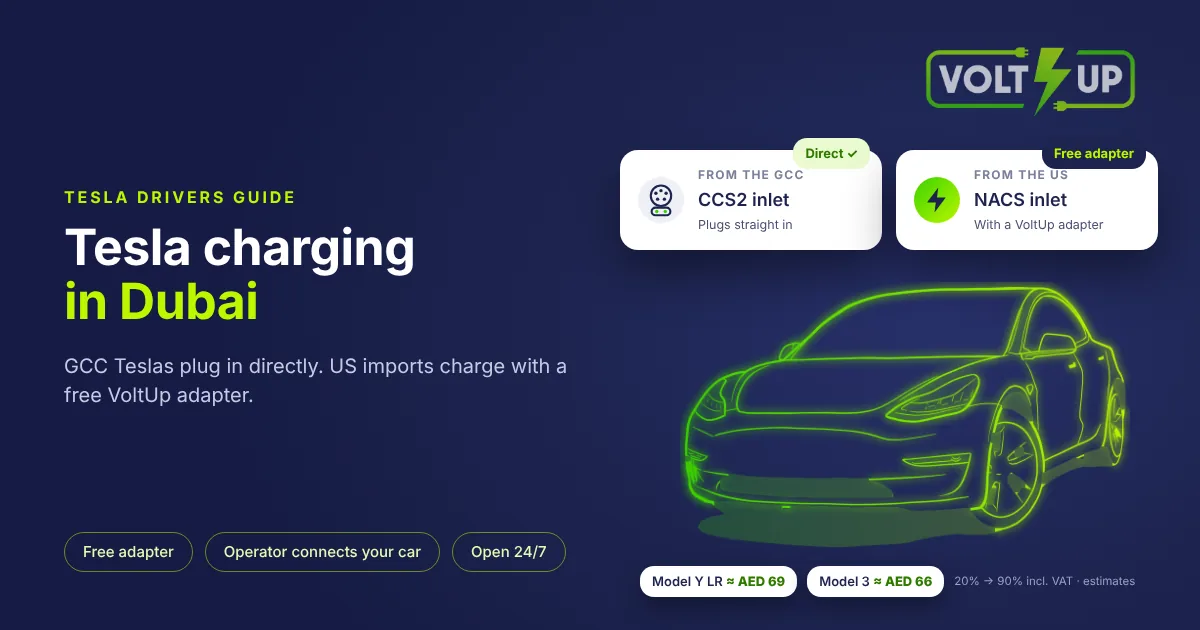
For Tesla charging in Dubai, where the car was first sold decides how it plugs in: Teslas bought in the GCC use CCS2 and plug in directly, and Teslas imported from the US use NACS and charge with a VoltUp adapter. In most cases the team simply brings the right adapter, free to use, so there is nothing for you to check.
For daily charging, Tesla's UAE support page ("Range Tips") and its Model 3 and Model Y owner's manuals for the UAE, as read in November 2026, advise about 80% on cars with an 80% recommended limit, and keeping 100% for when it is needed, for example before a long trip. The same sources advise avoiding long periods near 0% or 100%. Our sessions stop at 95%, but if your Tesla is set to a lower daily limit, follow the car; driving an EV in Dubai without a home charger explains daily limits for other batteries.
VoltUp EV Charging Station is at 22B Street 25, Umm Ramool, Dubai, UAE, and it is open 24/7, every day of the year, with a VoltUp team on site.
GCC Teslas and US imports
On airport work, the Teslas we see most are the Model Y, then the Model 3, and some Model X. At Umm Ramool we have charged the Model 3, Model Y, Model S, Model X and Cybertruck; check your model on our EV compatibility page.
Teslas bought in the GCC have a CCS2 inlet. All our chargers are DC chargers with CCS2 connectors, so a GCC Tesla plugs straight in.
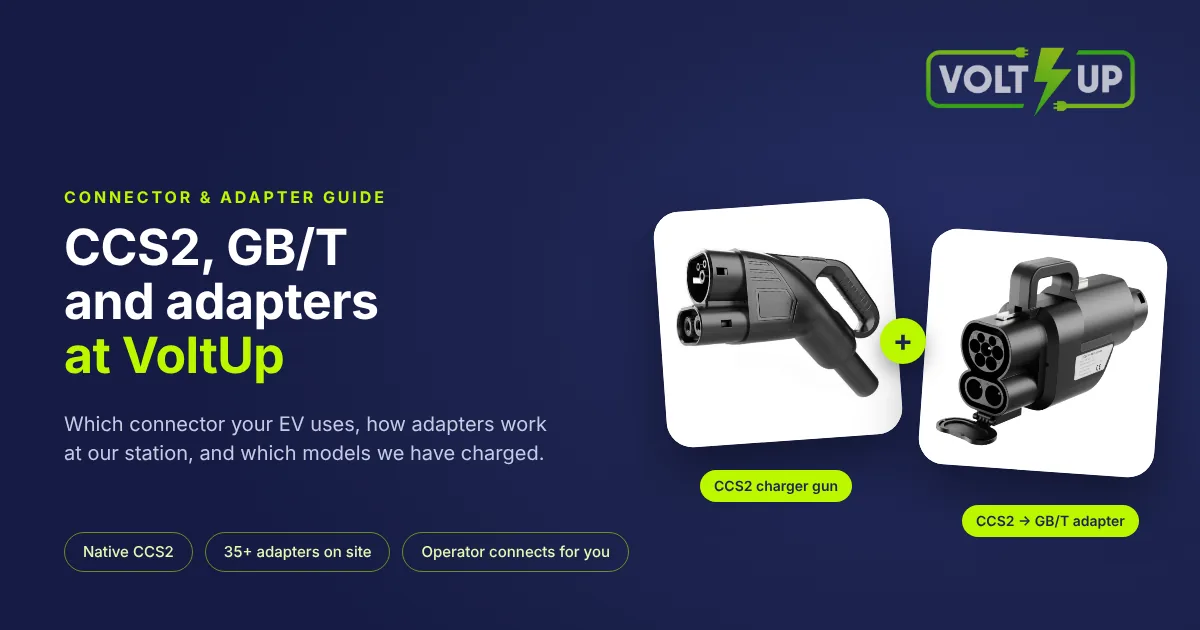
Teslas imported from the US have a NACS inlet. They charge at VoltUp with a VoltUp adapter between the charger's CCS2 gun and the car. We always use our own VoltUp-certified adapters, matched to your car and to our chargers, and they are free to use. If your car came with an adapter of its own, please leave it in the car. The team handles, maintains and checks the adapters every day.
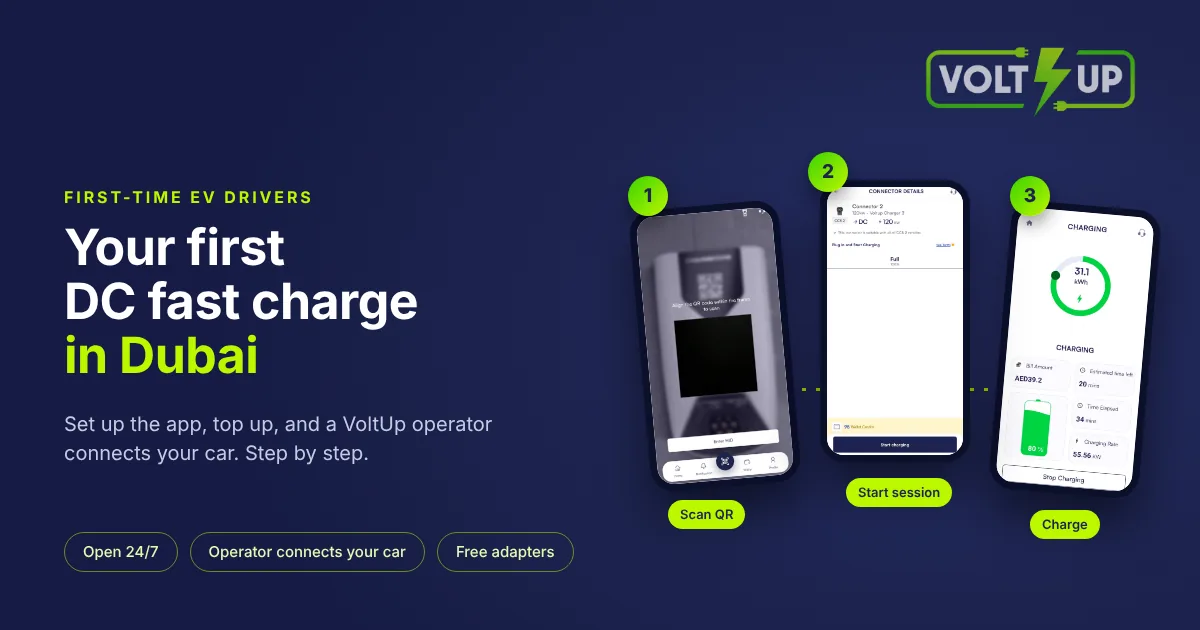
You do not connect anything yourself: a VoltUp operator fits the adapter and the cable, and you then start the session in the VoltUp app, as shown in your first DC fast charge, step by step. If a session stops, see why a session stops, and how our operators fix it.
Most, but not all, EVs on UAE roads can charge at VoltUp. If your Tesla came from another market and you are not sure which inlet it has, ask us first: call or WhatsApp +971 52 557 6145, monitored 24/7.
What charging a Tesla costs
Charging a Tesla costs the same AED 1.20/kWh + 5% VAT (AED 1.26/kWh including VAT) as any other car, and the adapter is free. The table uses the method of VoltUp pricing: a charge from 20% to 90%, which is 70% of the battery size, at the public tariff.
| Tesla | Battery size | Energy from 20% to 90% | Cost at the public tariff |
|---|---|---|---|
| Model Y Long Range | 78.1 kWh | about 54.7 kWh | about AED 65.60 + 5% VAT (AED 68.88 including VAT) |
| Model 3 | 75.0 kWh | 52.5 kWh | about AED 63.00 + 5% VAT (AED 66.15 including VAT) |
These are estimates.
Driving a Tesla does not make public charging free; is EV charging free in Dubai? explains what to check.
How fast a Tesla charges
When Tesla drivers talk to the team, one question comes first: "How fast can your charger charge my car?" Tesla drivers ask little else. The answer starts with the car: no car charges faster than its own maximum DC power. For the Tesla Model Y Long Range that maximum is 250 kW. The charger has a limit of its own too, so the power your car gets is the lower of the two.
Within those limits, the conditions on the day set the power, as explained in why your car charges slower than the number on the charger.
Questions drivers ask
Does a Tesla need an adapter at VoltUp?
Not if it was bought in the GCC: those Teslas use CCS2 and plug in directly. Teslas imported from the US use NACS, and a VoltUp operator connects them with one of our adapters. Full answer
More from VoltUp
To check your own car, see which EVs can charge at VoltUp. For adapters in more depth, read CCS2, GB/T and EV charging adapters in Dubai.