Driving an EV in Dubai without a home charger
Can you drive an EV in Dubai without a home charger? What VoltUp sees at the hub, how drivers fit charging into their week, and what to check first.
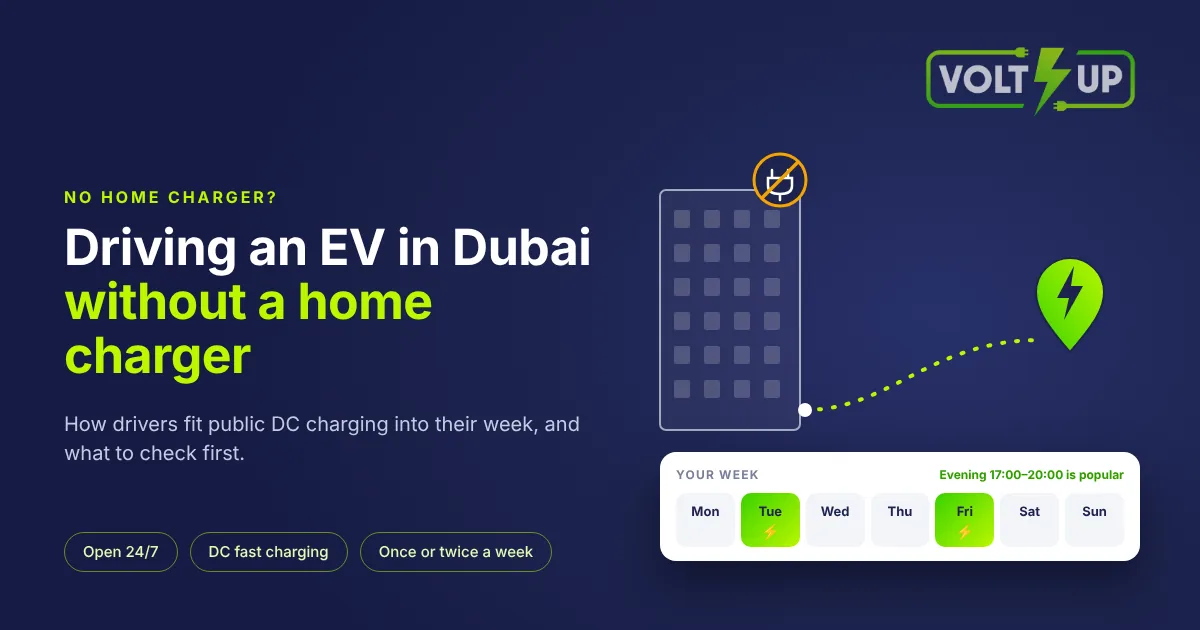
You can drive an EV in Dubai without a home charger if public DC charging fits your routes and your week. At VoltUp we see private drivers from nearby areas who have no charger at home and charge with us once or twice a week, often in the evening.
Some of them have not left their petrol car behind. At VoltUp we also see households that keep their petrol car, often a larger SUV, and drive electric next to it. If you enjoy your car, trying electric for daily driving does not mean saying goodbye to it.
Can you charge an EV in Dubai if your building has no charger?
Not everyone can plug in at home. Some villas and townhouses have their own AC charger, but many apartment buildings, older and newer, were not built with EV parking in mind. Shopping centres more often offer AC than DC charging, and at some of them you bring your own cable. Some employers also ask their people to drive electric, whether or not they have a charger at home.
That is where a public DC hub fits. VoltUp has no AC charging: all our chargers are DC with CCS2 connectors. For how AC and DC differ, read DC fast charging explained.
A city-wide number says little about your own week. WAM reported 2,826 EV charging points in Dubai at the end of the third quarter of 2026 (WAM, 23 Oct 2026). That count includes DEWA's own stations and independent operators licensed by DEWA, and it counts charging points, not locations or fast chargers. What matters is whether a place on your routes suits you.
How charging fits into a week
Many drivers from the areas around the hub charge with us once or twice a week. The two main groups are commercial drivers who live nearby and private drivers without a home charger. Many of those private drivers come straight from work, between about 17:00 and 20:00. The app shows availability before you set off, but it can change before you arrive, and the app does not offer reservations. How often your own car needs charging depends on the car and the kilometres you drive.
A typical session at our hub is roughly 45 to 50 kWh, from our own figures since the station opened in February 2026. Set that against the real consumption of the car you are considering and your weekly kilometres, and you have a first idea of how often you would come.
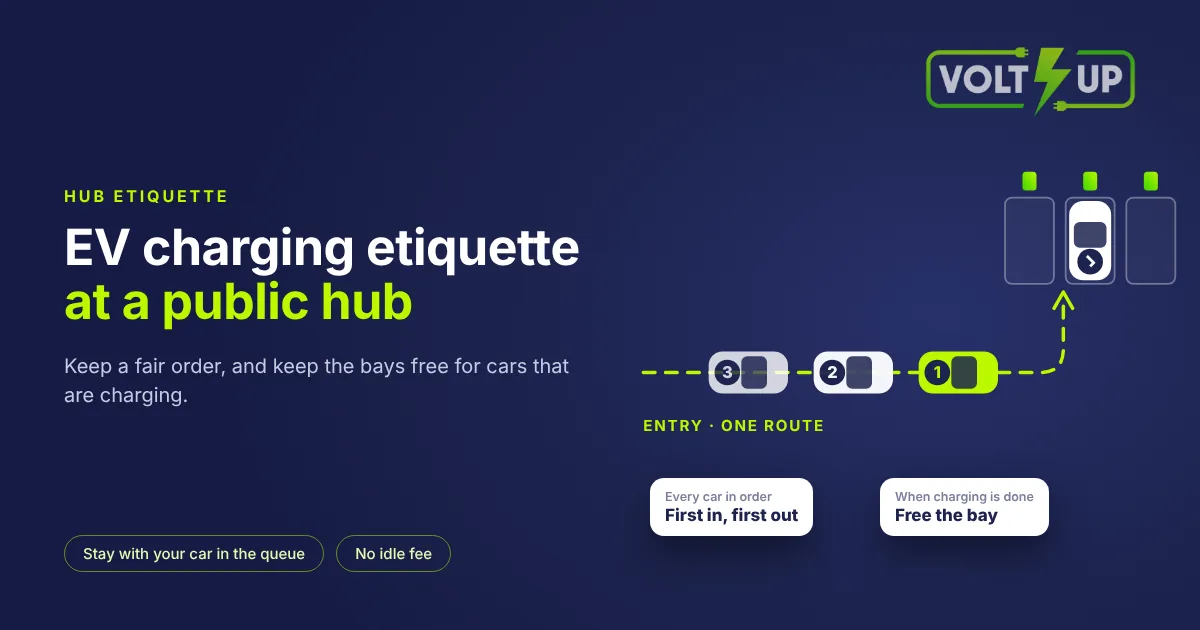
The station is open 24/7, every day of the year, including public holidays, and a VoltUp team is on site 24/7. Stay with your car while it waits its turn; once a VoltUp operator has connected it to a charger, you are free to wait in the air-conditioned waiting area. The station page lists the facilities. Commercial and fleet drivers have their own needs, so they have their own page: fleet charging.
Before you buy, work through this list:
Write down your daily kilometres and the real consumption of the model you are considering, not only the brochure range.
Check the charging places on your routes: how you get in, opening hours, how you pay and which connector they use.
Confirm that the exact car can charge there, especially if it was imported: check your model on our EV compatibility page.
Find a second place you could use if the first does not fit that day.
Keep three times apart: the drive to the charger, any wait, and the charging session itself.
What changes in cost
Petrol has become more expensive this year: WAM reported UAE Special 95 at AED 2.33 per litre in February 2026 and AED 4.04 per litre in November 2026, although November was 5.6% lower than October.
Drivers around the hub tell us that running costs are one reason they switch, and that for many of them charging an EV costs less than filling a petrol car for the same daily driving.
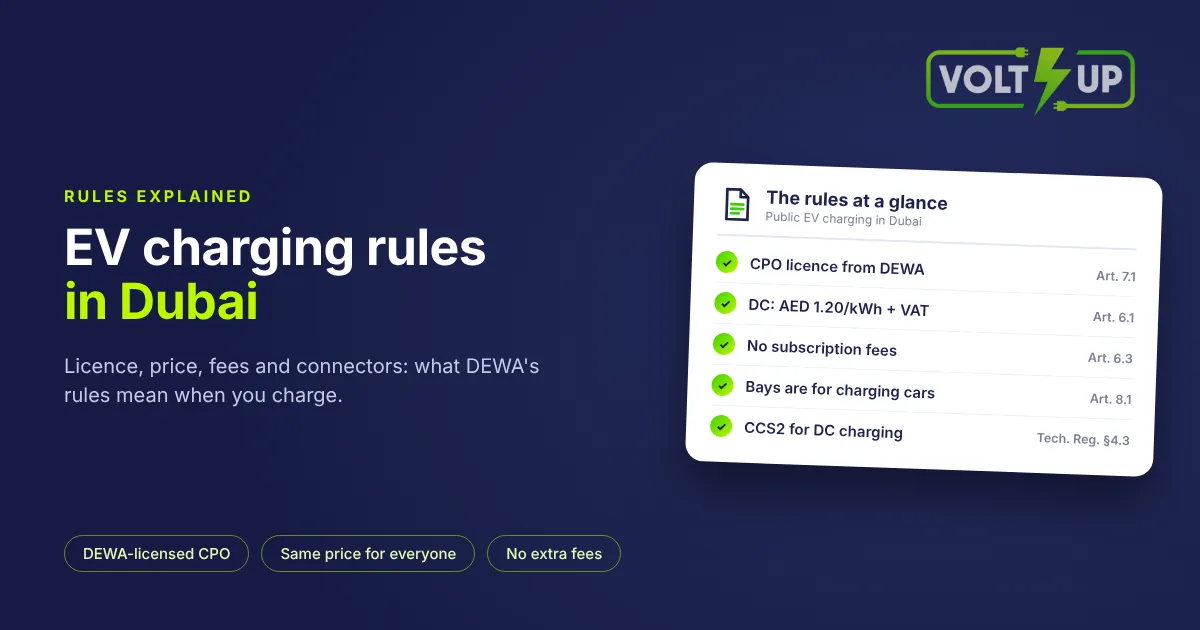
Charging at VoltUp costs AED 1.20/kWh + 5% VAT (AED 1.26/kWh including VAT), the same tariff for every customer, with no extra fees and no subscription; VoltUp pricing has examples by car.
For your own comparison, take the consumption of the car you are considering and the kilometres you expect to drive. If you are adding a second car and keeping the first, count the purchase price, depreciation, insurance and other extra costs too. A lower fuel bill does not make a second car a saving on its own.
Summer heat and charging time
Dubai's summer heat reaches the charging session. From June to September, the battery management system (BMS) of many cars runs hot. If heat stops a session, the VoltUp team on site handles it for you; why a charging session stops shows what the operator does.
Many drivers new to EVs are afraid at first that charging will take long, until they visit us. How long it takes depends on the car and on whether it shares a charger, as EV charging speed in Dubai explains.
What drivers tell us about running an EV
Drivers who come from heavy V8 and other petrol cars tell us they enjoy that an EV needs so little looking after. Drivers also tell us that maintenance is mostly topping up fluids now and then, which almost any EV garage can do.
Buying used: what to check
At the hub we also see growing interest in young used EVs. Dubai's summers are hard on cars, and we fairly often see complications, partly because many cars here have not been well maintained. For that reason, a used car deserves a careful look.
Ask for:
the battery condition, checked by a proper inspection;
the service and damage history;
the warranty that really applies to that car in the UAE;
local service support;
a charging inlet that suits the places you plan to use. We can charge most EVs on UAE roads, with adapters for GB/T, CCS1 and Tesla (NACS) cars, but we do not support CHAdeMO.
Charging limits and your battery
The right daily charge limit depends on the car and its battery. Some cars recommend about 80% or below 90% for daily driving and 100% only before a long trip. BYD's Blade battery is an LFP battery, and BYD's own pages give no daily charging percentage. Your car's screen or manual shows the limit for your car.
Our own advice at VoltUp is to charge to about 90% for battery life, and to follow your manufacturer's guidance. At our hub we often see the range of cars with nickel-based batteries decline over time, more than with newer battery technology. Some models of the same make use different batteries, so ask which battery the car you are considering has, and check its condition.
If you already drive a BYD, BYD charging in Dubai covers what a charge costs and how an imported car is connected.
Sources: BYD, "BYD Blade Battery"; Tesla Support UAE, "Range Tips", and Tesla owner's manuals (checked November 2026).
What a first visit looks like
Enter from 22B Street 25 in Umm Ramool, follow the VoltUp signs and park in the bay the team directs you to.
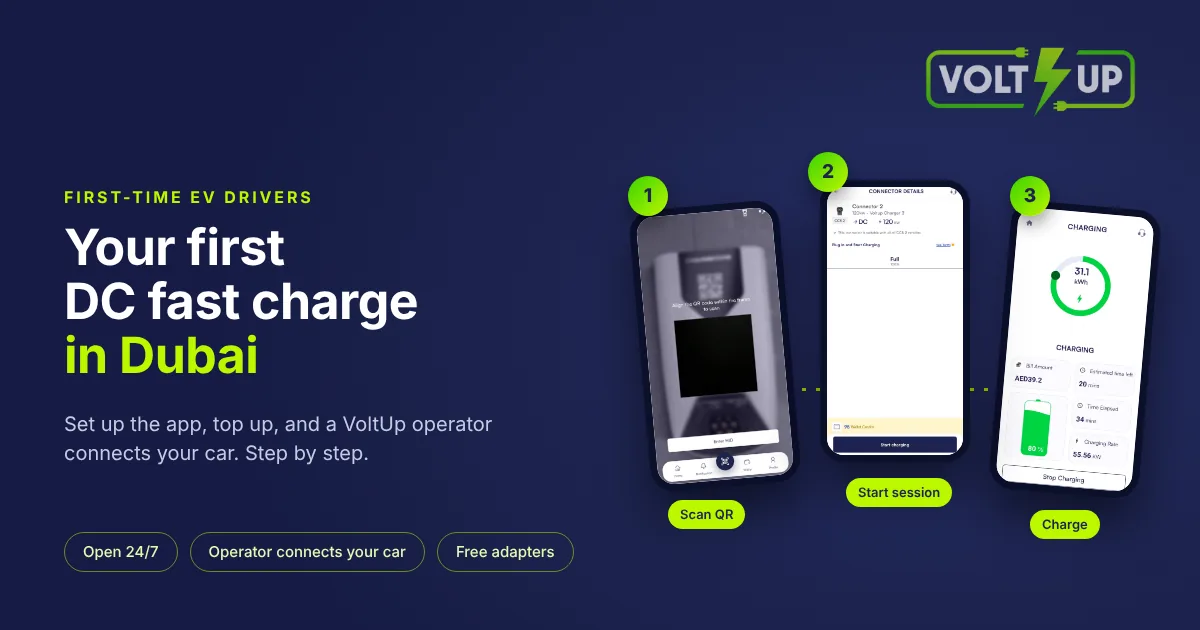
If you have never charged with us, the team helps you set up the app and top up on the spot; your first DC fast charge, step by step shows everything that happens at the bay.
Coming after dark works the same way, with several operators on site through the night; EV charging at night in Dubai has the rest.
Your routes, your car and the places you can charge decide whether electric works for you. Whether public charging fits your week is the question to answer before you buy.
Questions drivers ask
Do I need a charger at home to drive an EV?
No, but you need a place to charge that fits your week. Private drivers without a home charger charge with us, many of them once or twice a week. Check your own routes and kilometres first.
Which daily charge limit should I use?
The one your car's screen or owner's manual gives for its battery; BYD's Blade battery pages name no daily percentage. Our own advice is about 90% for battery life.
Can my imported car charge?
Most EVs on UAE roads can, though not every one: cars from official GCC dealers plug in directly, and cars imported from China or the US charge with a VoltUp adapter. Check the EV compatibility page for your model.