EV charging rules in Dubai: licence, price, fees and connectors
EV charging rules in Dubai in plain words: who may run a public charger, the regulated price, the fees that are not allowed, and connectors.
EV charging rules in Dubai come from DEWA: only DEWA and the operators it licenses may run public chargers, and the fee for public DC charging is set by regulation (DEWA Infrastructure Regulation, Articles 7.1 and 6.1, November 2025). VoltUp is a DEWA-licensed charge point operator (CPO) and charges AED 1.20/kWh + 5% VAT (AED 1.26/kWh including VAT), with no extra fees.
The rules apply to every public charger in the city; below is each one, with how it works at our hub in Umm Ramool.
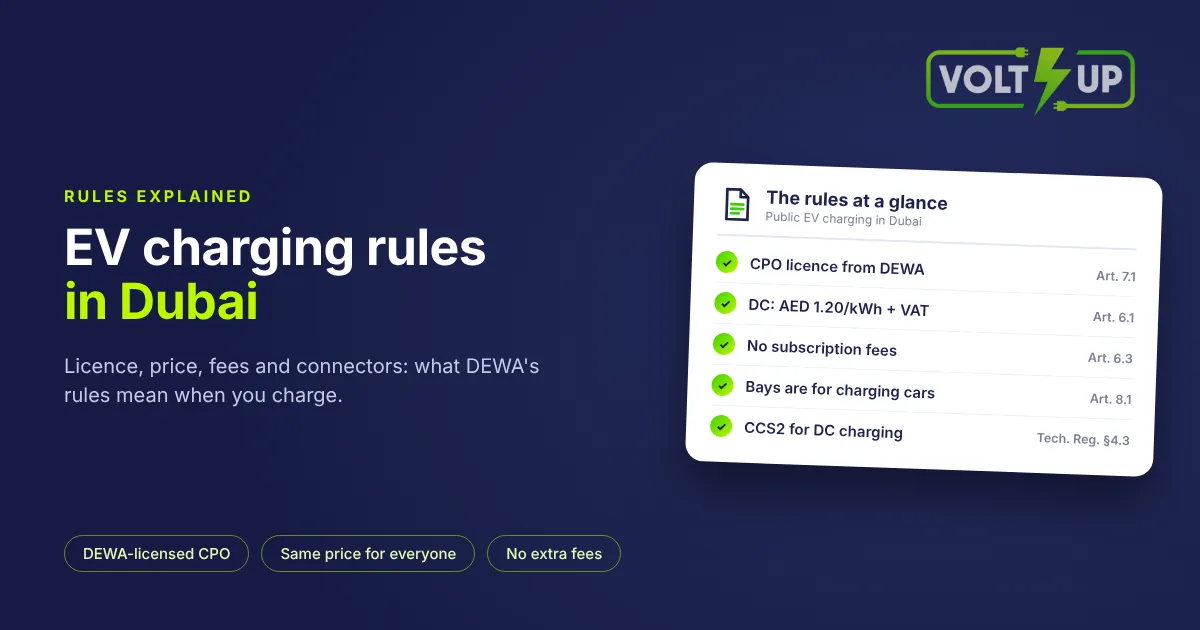
The rules at a glance
| The rule | What it means for you | Source |
|---|---|---|
| Public charging needs a CPO licence from DEWA | A public charger is run by DEWA or a DEWA-licensed operator | DEWA Infrastructure Regulation, Art. 7.1 |
| Public DC charging: AED 1.20/kWh + 5% VAT (AED 1.26/kWh including VAT) | The same fee per kWh, with no discount or subscription below it | DEWA Infrastructure Regulation, Art. 6.1; Cabinet Resolution No. 81 of 2024 |
| Public AC charging: AED 0.70/kWh plus VAT | AC has its own, separate fee | DEWA Infrastructure Regulation, Art. 6.1.a |
| No subscription fees, no higher parking charge for EV users, no other compensation for charging | You pay for the energy, not for a membership | DEWA Infrastructure Regulation, Art. 6.3 |
| Bays are for EVs that are charging; overstay charges only if they are in the terms and shown at the charger | An overstay charge must be written where you can see it | DEWA Infrastructure Regulation, Art. 8.1 and 8.2.b |
| Native connectors: Type 2 for AC, CCS2 for DC | Public DC chargers use CCS2 | DEWA Technical Regulations, §4.3 |
| A session starts by RFID card, QR code, app or Plug & Charge; status and kWh are shown | At least one of these starts your session, and you can see the kWh used | DEWA Technical Regulations, §6.5 and §6.3 |
Who may run a public charger
Running public charging in Dubai without a CPO licence from DEWA is not permitted (DEWA Infrastructure Regulation, Article 7.1, November 2025). A CPO, or charge point operator, is the company that runs the chargers and bills you for the session.
VoltUp is a DEWA-licensed charge point operator (CPO). We received our licence in February 2026 and opened the hub that same month. We are entry 27 on DEWA's published list of licensed CPOs in Dubai, dated 17 June 2026.
DEWA publishes the list of licensed operators, so you can check who runs the charger you use.
The price is set by regulation
The fee for public DC charging in Dubai is AED 1.20/kWh + 5% VAT (AED 1.26/kWh including VAT), set by DEWA's Infrastructure Regulation of November 2025 (Article 6.1, guided by Cabinet Resolution No. 81 of 2024). The same article forbids a discount, a preferential rate or a subscription below that fee. Public AC charging has its own fee of AED 0.70/kWh plus VAT (Article 6.1.a).
At VoltUp every customer pays the same tariff, fleet or private, day or night. That is also why there are no fleet discounts: the regulation does not allow a rate below the set fee. See VoltUp pricing for price examples by car.
No subscriptions and no other charges
Operators in Dubai may not charge subscription fees, may not charge EV users more for parking than other users, and may not collect other compensation for charging (DEWA Infrastructure Regulation, Article 6.3, November 2025).
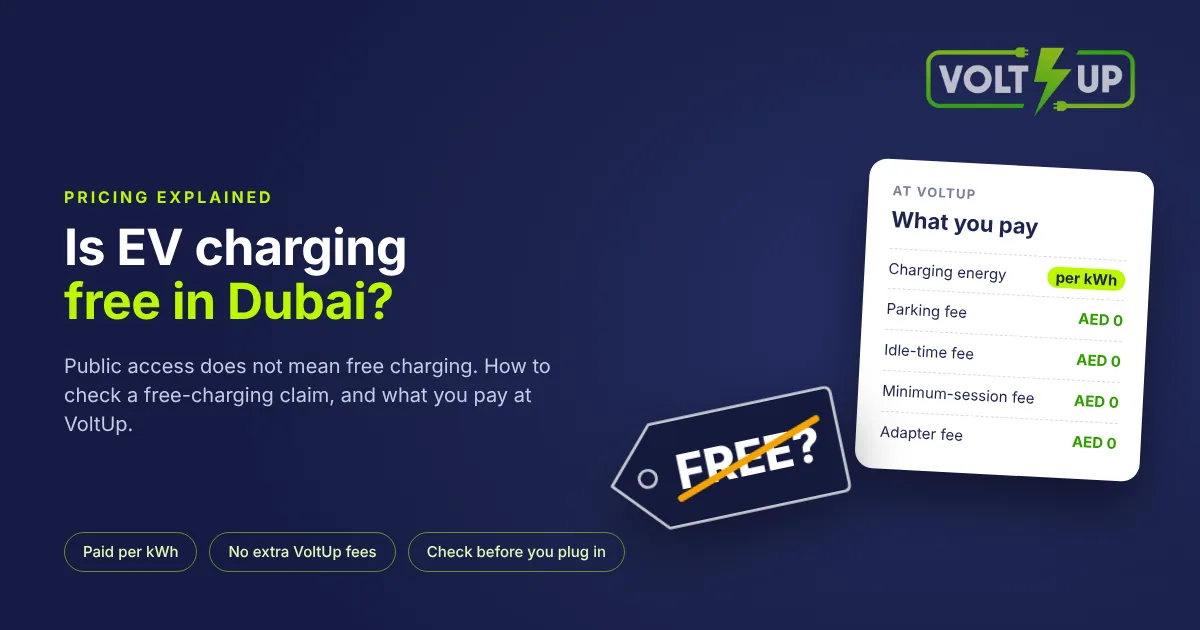
At VoltUp there is no connection fee and no paid subscription or membership. We charge no parking, idle-time, minimum-session or adapter fees either. There is no contract or lock-in for any customer: you pay per kWh and you are free to stop.
Bays are for charging cars
Charging bays are for EVs that are charging, and an operator may add overstay charges only if they are in its terms and displayed at the charger (DEWA Infrastructure Regulation, Articles 8.1 and 8.2.b, November 2025). VoltUp has no overstay charge.
At our hub there is no parking without charging, and the on-site team asks drivers to free the bay once charging has finished.
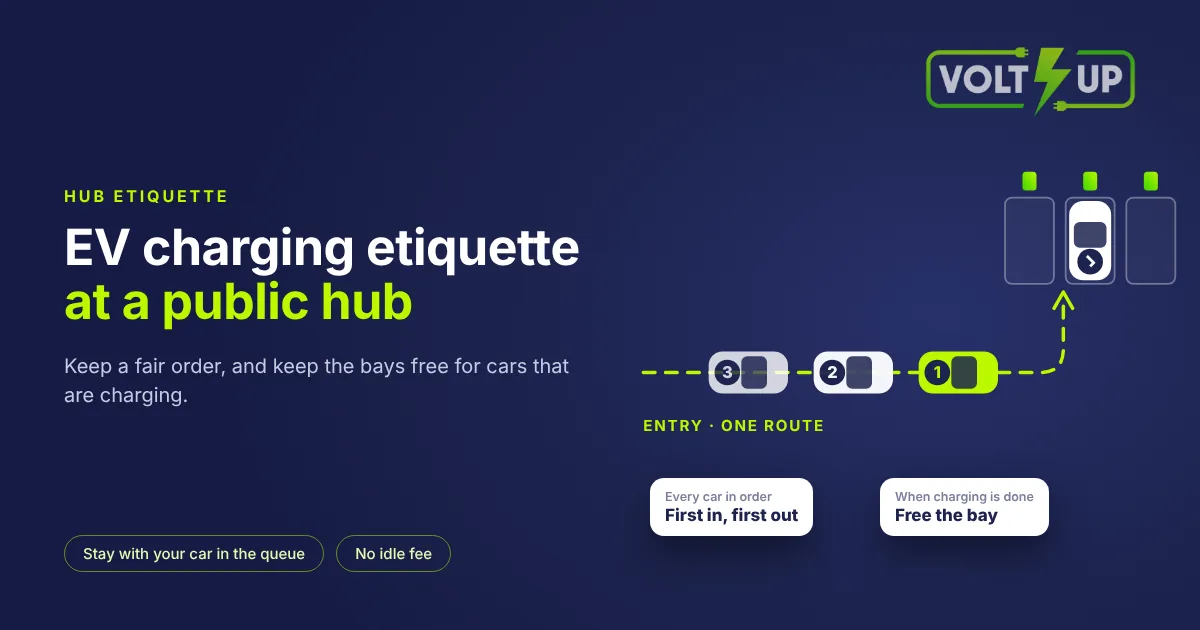
The rule drivers get wrong most often, in our experience, is the order at the charger: at our hub it is first in, first out, as our guide to EV charging etiquette explains.
Connectors
A public charger's native connectors must be Type 2 for AC or CCS2 for DC (DEWA Technical Regulations, section 4.3, May 2025). We have no AC charging: all our chargers are DC with CCS2 connectors.
Cars sold through official GCC dealers use CCS2 and plug in directly. For cars with another inlet, see which EVs can charge at VoltUp.
Starting a session and what you see
DEWA's Technical Regulations (May 2025, sections 6.5 and 6.3) say a public charger starts a session by at least one of these: an RFID card, a QR code, the operator's app or Plug & Charge (ISO 15118). It should also show the session status and the kWh used, for example on its display or in the operator's app.
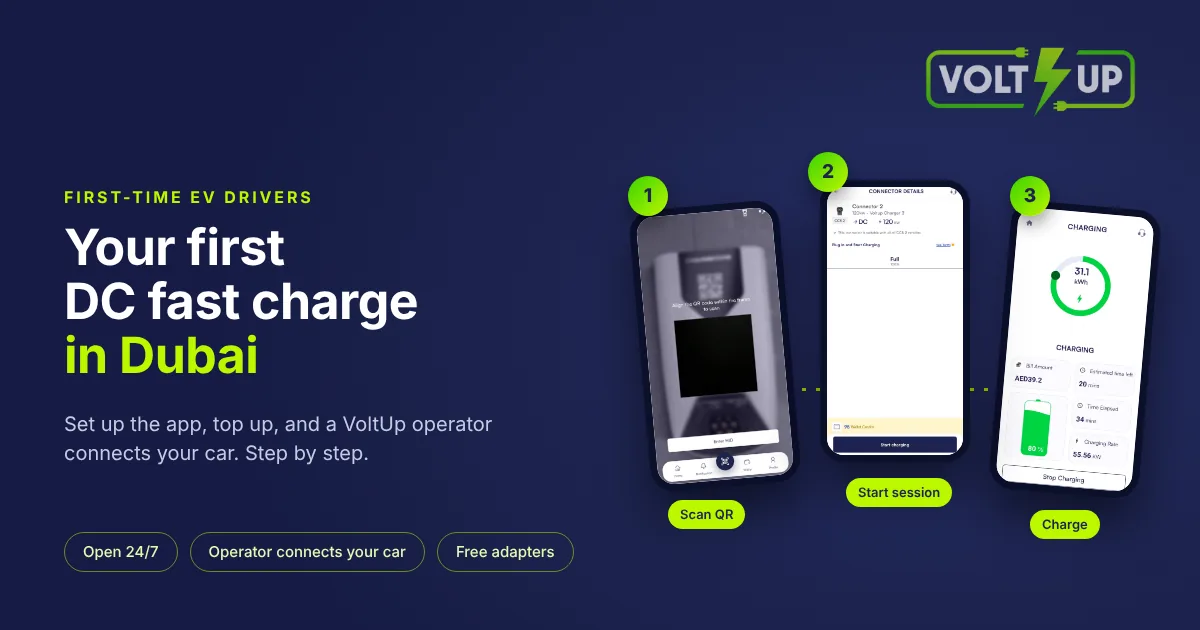
At VoltUp you start in the VoltUp app by scanning the QR code on the charger, or with an RFID card linked to your app account, and you pay from the in-app wallet. RFID cards are free for every customer, and fleets can ask for Autocharge: once a VoltUp operator has plugged the car in, the charger recognises it and starts the session, for supported cars.
Before you scan, a VoltUp operator connects the cable for you, and during the session the charger screen and the app show the battery percentage and an estimated time until done. Your first DC fast charge, step by step walks through the whole visit.
Your invoice
Every customer receives a VAT tax invoice for the exact kWh charged, in the app and by email. The app receipt shows the actual kWh and the amount of each session. Fleets receive one consolidated tax invoice on the 1st of each month.
Questions drivers ask
Who is allowed to operate public EV chargers in Dubai?
Only DEWA and operators with a CPO licence from DEWA (DEWA Infrastructure Regulation, Article 7.1, November 2025). Full answer
Why does EV charging cost the same everywhere in Dubai?
The fee for public DC charging is set by regulation at AED 1.20/kWh + 5% VAT (AED 1.26/kWh including VAT), with no discount below it (DEWA Infrastructure Regulation, Article 6.1, November 2025). Full answer
Is VoltUp licensed by DEWA?
Yes. VoltUp is a DEWA-licensed charge point operator (CPO) and is on DEWA's published list of licensed CPOs, dated 17 June 2026. Full answer
Do I get a VAT invoice?
Yes, for the exact kWh charged, in the app and by email. Full answer
More from VoltUp
See VoltUp pricing for price examples by car, read about VoltUp and how the hub started, and find out whether EV charging is free in Dubai.
Sources: DEWA, Electric Vehicles Charging Infrastructure Regulation for the Emirate of Dubai, version 1.3 (November 2025), Articles 6.1, 6.1.a, 6.3, 7.1, 8.1 and 8.2.b; UAE Cabinet Resolution No. 81 of 2024 on the unified charging tariff; DEWA EV Charging Technical Regulations, version 1.0 (May 2025), sections 4.3, 6.3 and 6.5; DEWA's published list of licensed charge point operators in Dubai (17 June 2026). Checked November 2026.