BYD charging in Dubai: cost and tips at a DC charging station
Charge your BYD at VoltUp Umm Ramool: CCS2 for GCC cars, free adapters for imports. AED 1.20/kWh + 5% VAT (AED 1.26/kWh including VAT).
The BYD Han is the most common car we see at VoltUp Umm Ramool, our DC charging station in Dubai. Drivers of a Han with Chinese specifications often ask us whether it can charge here with an adapter, how that works and what it costs. It can: a VoltUp operator connects one of our adapters, the adapter is free for every customer, and you pay for the kWh you charge, at AED 1.20/kWh + 5% VAT (AED 1.26/kWh including VAT). BYDs sold through official GCC dealers plug in directly on CCS2.
The station is open 24/7. Here is how a BYD charges with us, what a charge costs, what sets the speed and how our team connects an imported BYD.
BYD at VoltUp
On airport work, where many of our customers are limousine and taxi drivers, the Han is one of the cars we see most often. Our list of models charged at Umm Ramool (October 2026) also includes the BYD Atto 3, Dolphin, Seal, Seal U, Sealion 7, Tang and Song Plus (plug-in hybrid). The full list is on our EV compatibility page.
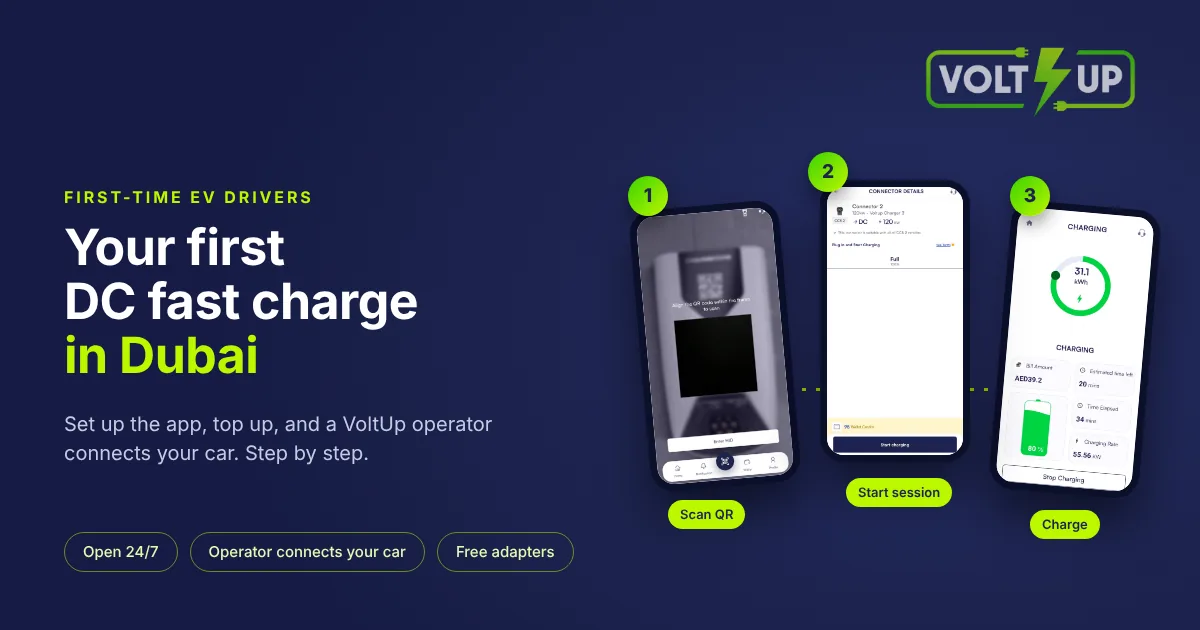
Charging a BYD here works as for any other car, as described in your first DC fast charge, step by step: a VoltUp operator plugs it in and you start the session in the app. Enter from 22B Street 25, follow the VoltUp signs and open the directions to VoltUp Umm Ramool to plan your route.
What a charge costs
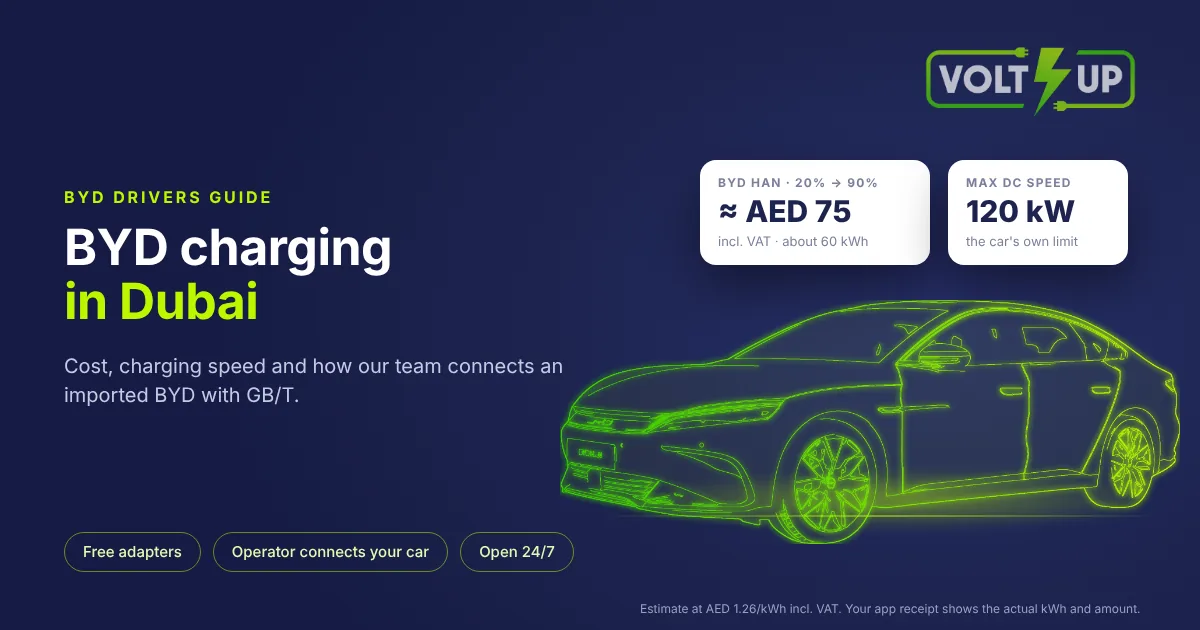
On VoltUp pricing we work out the cost by car for a charge from 20% to 90%, which is 70% of the battery. For a BYD Han with its 85.4 kWh battery that is 59.78 kWh, or about AED 71.74 + 5% VAT (AED 75.32 including VAT) at the public tariff of AED 1.20/kWh + 5% VAT (AED 1.26/kWh including VAT). The figure is an estimate; your receipt in the app shows the actual kWh and amount of each session.
How fast a BYD Han charges
The question BYD drivers ask our team most is: "How fast can your charger charge my car?" We answer with the car's own limit: the BYD Han takes up to 120 kW on DC, and each of our DC chargers is rated 120 kW today. A car never charges faster than its own maximum, so 120 kW is the ceiling for a Han.
That is why sharing matters most for a Han. When two cars share one charger, today each gets a fixed maximum of 60 kW, half of what a Han can take on a charger of its own. What a Han really gets on the day also depends on its battery management system, the battery temperature and the charge level, as EV charging speed in Dubai explains.
The Blade battery and the daily limit
BYD's Blade battery is a lithium iron phosphate (LFP) battery, according to BYD's own Blade Battery pages (BYD UK, read in November 2026). Those pages give no daily charging percentage. Follow the daily limit on your car's screen or in its owner's manual; how daily limits differ between battery types is explained in driving an EV in Dubai without a home charger.
Imported BYDs with GB/T
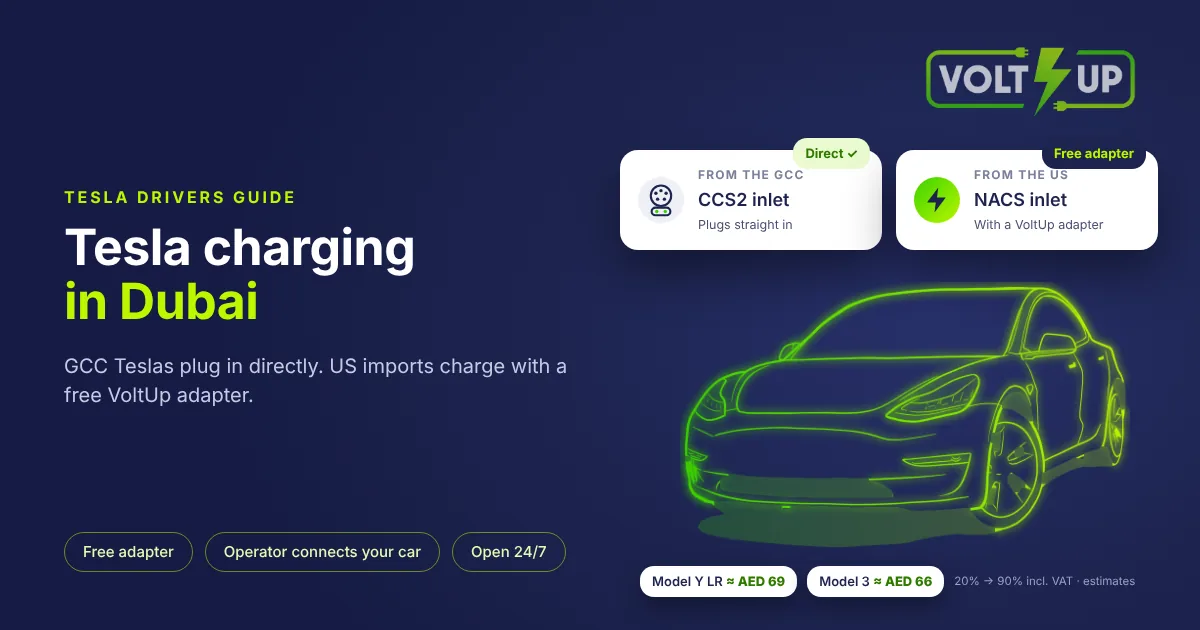
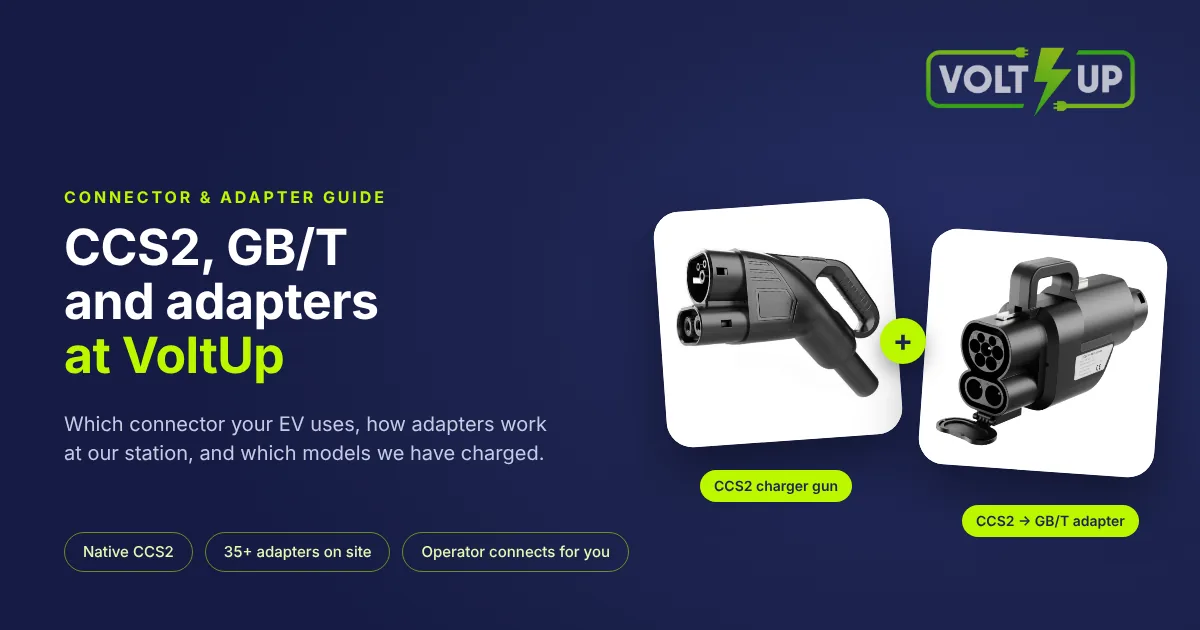
BYDs imported from outside the GCC, for example from China, can have a GB/T inlet, while our chargers are CCS2. We keep more than 35 adapters on site for GB/T, CCS1 and Tesla (NACS) cars. We always use our own VoltUp-certified adapters, free to use and matched to your car and our chargers, so please leave the adapter that came with your car in the car. Adapters that come with many Chinese cars are often of poor quality and can overheat. Ours are high-quality adapters that do not reduce charging power. Their firmware is simple to update, which is why the link with a car nearly always works the first time.
A GB/T adapter needs a few steps in a set order before the QR code can be scanned, and the team takes care of them; CCS2, GB/T and EV charging adapters in Dubai shows each step. If something looks wrong, ask the VoltUp operator at your bay rather than fixing the connector or adapter yourself. If you are not sure what your car has, ask the team first.
Should a session stop halfway, the operator restarts it, swaps the adapter or moves your car to another charger; why a charging session stops has the reasons we see.
Questions drivers ask
Can I charge a BYD at VoltUp?
Yes. BYDs sold through official GCC dealers plug in directly on CCS2, and imported BYDs with GB/T charge with one of our adapters, which a VoltUp operator connects. Full answer
How much does a full charge cost?
It depends on how many kWh your car takes, at AED 1.20/kWh + 5% VAT (AED 1.26/kWh including VAT). A BYD Han from 20% to 90% costs about AED 71.74 + 5% VAT (AED 75.32 including VAT). Full answer
Can I charge a Chinese-import EV with a GB/T connector?
Yes, in most cases. A VoltUp operator connects GB/T cars with one of our adapters, and Chinese brands bought from a GCC dealer plug in directly on CCS2. Full answer
More from VoltUp
See which EVs can charge at VoltUp for the full models list, and VoltUp pricing for cost examples by car. If your BYD has a GB/T inlet, read our guide to CCS2, GB/T and EV charging adapters in Dubai. To see how charger ratings and car limits work together, read about DC fast charging at VoltUp.