EV charging speed in Dubai: why your car charges slower than the number on the charger
Why your EV takes less kW than the charger's rating: the BMS, battery temperature, charge level and a shared charger, explained by our team in Dubai.
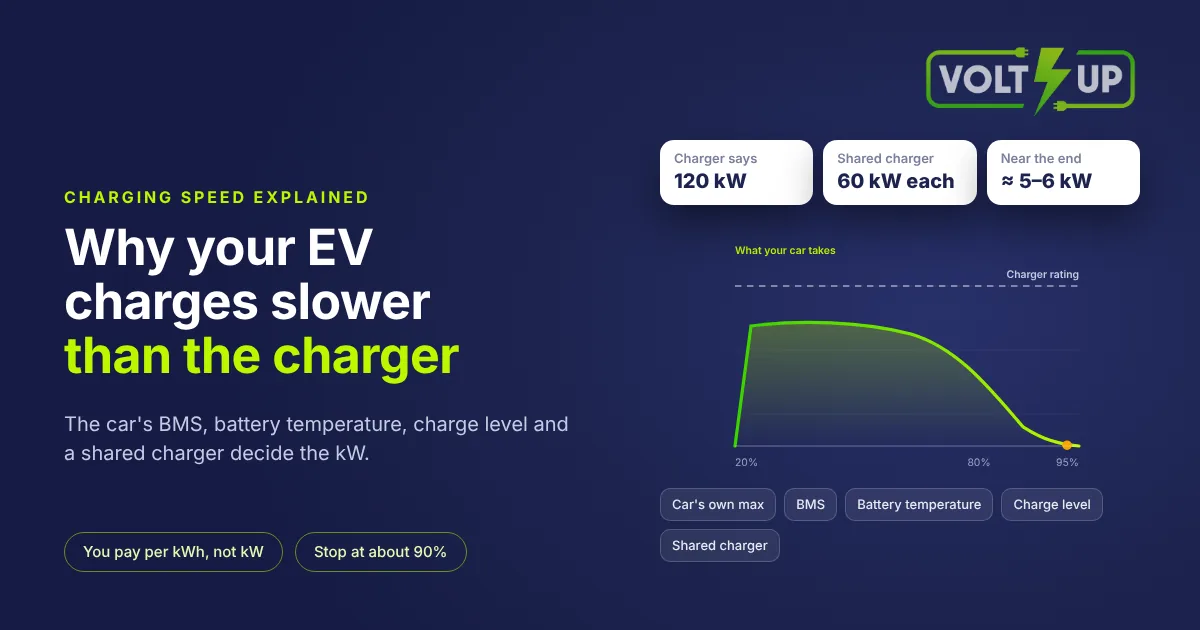
EV charging speed is set by your car as much as by the charger. The car's battery management system (BMS), the battery temperature and the charge level decide how much power it takes, and a car never charges faster than its own maximum.
When two cars share one charger, they also share its power. At VoltUp Umm Ramool today, a 120 kW charger with two cars gives each car a fixed maximum of 60 kW.
Why is my EV charging slow?
Drivers who see a lower number on the screen ask us why charging is fast or slow, and whether it can go faster. Seeing less than the charger's rating is normal. Five things decide the power, and four of them sit in the car.
| What sets the power | What it means at the bay |
|---|---|
| The car's own maximum | A car never charges faster than its maximum DC power, whatever the charger's rating. |
| The battery management system (BMS) | The BMS decides how much power the battery accepts at each moment. |
| Battery temperature | A battery that is too hot or too cold takes less power. |
| Charge level | The fuller the battery, the less power it takes, and near the end it can drop to about 5 or 6 kW. |
| A shared charger | Two cars on one charger share its power: today at most 60 kW each on a 120 kW charger. |
kW and kWh in one minute
A kW (kilowatt) is power: how fast energy flows into the battery at a given moment. A charger's rating, such as 120 kW, is the most power it can deliver. A kWh (kilowatt hour) is energy: how much has gone into the battery in total. One hour at 1 kW is 1 kWh.
An example from our own figures: since the station opened, a typical customer session has been roughly 45 to 50 kWh. That number is energy. The figure on the screen during the session is power, and it moves up and down as the BMS asks for more or less. Two cars can take the same 45 kWh, one at high power and one at low power: the energy is the same, only the time differs.
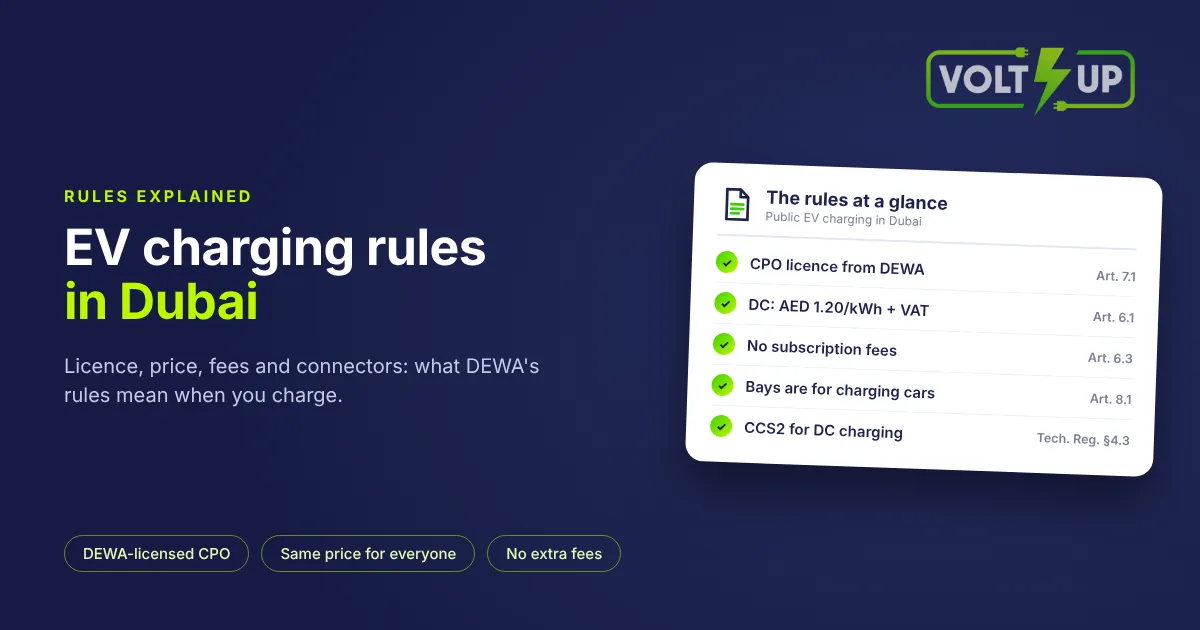
You pay for the kWh, not for the kW: AED 1.20/kWh + 5% VAT (AED 1.26/kWh including VAT). A slower session takes more of your time, but the same energy costs the same amount, with no idle-time or minimum-session fees; VoltUp pricing has examples by car.
Your car sets the limit
Every EV has a maximum DC charging power, set by its maker. A car never charges faster than that maximum, whatever the charger offers. Three examples from our DC fast charging page:
BYD Han (85.4 kWh battery): up to 120 kW.
Tesla Model Y Long Range: up to 250 kW.
Mercedes-Benz EQS 450+ (118 kWh battery): up to 200 kW.
The BYD Han is the most common car we see at Umm Ramool. On a 120 kW charger, the Han's own limit and the charger's rating are the same number, so the other factors in the table decide what you see on the screen. For a car not listed here, the maker's own figures show its maximum. Han drivers will find the cost of a charge and how an imported Han is connected in BYD charging in Dubai.
Within that maximum, the car's BMS decides how much power the battery accepts. It watches the battery's temperature and charge level and changes the power as the session goes on. The charger offers the power, and the BMS decides how much of it to take.
Battery temperature
A battery that is too hot or too cold takes less power, because the BMS protects it.
At Umm Ramool we see this from June to September, when many cars' BMS run hot.
Few drivers precondition their battery before they come to us, and many do not need to: they have driven some distance to the hub, so the battery is often already warm and charges well straight away.
Why the last part is slower
Many drivers arrive at about 20% and charge to 95%. A battery generally takes more power when it is low and less as it fills, so the end of a session is the slow part.
Going from 80% to 90% takes long compared with the range it adds. That is why we recommend charging to about 90% for battery life. The right daily limit also depends on the type of battery; driving an EV in Dubai without a home charger covers that.
When the car's BMS asks for little power near the end, we see the output drop to about 5 or 6 kW. Charging from about 80% to 94% then takes very long, and in our experience it is not worth the time.
Sessions at VoltUp stop at 95% state of charge. This is our choice, so nobody wastes time, the next driver does not wait unnecessarily and everyone charges efficiently.
Two cars on one charger
New drivers often ask us: "The charger shows 120, why do I get 60?"
A charger at VoltUp has two cables, so it can charge two cars at the same time, and the two cars then share its power: today a fixed maximum of 60 kW each on a 120 kW charger.
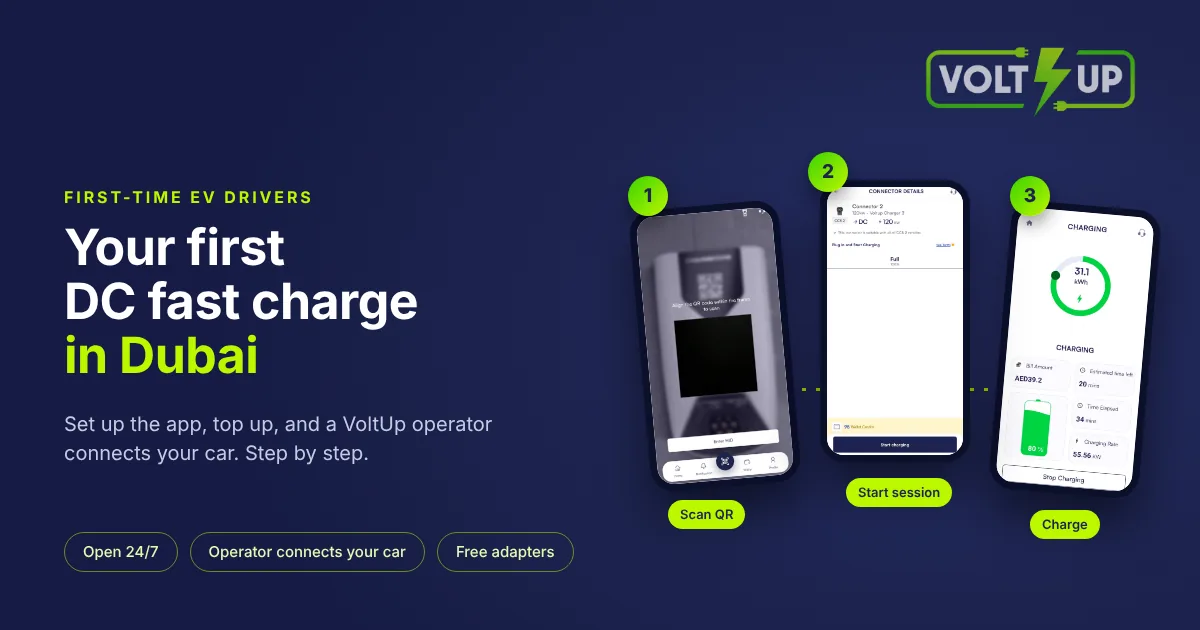
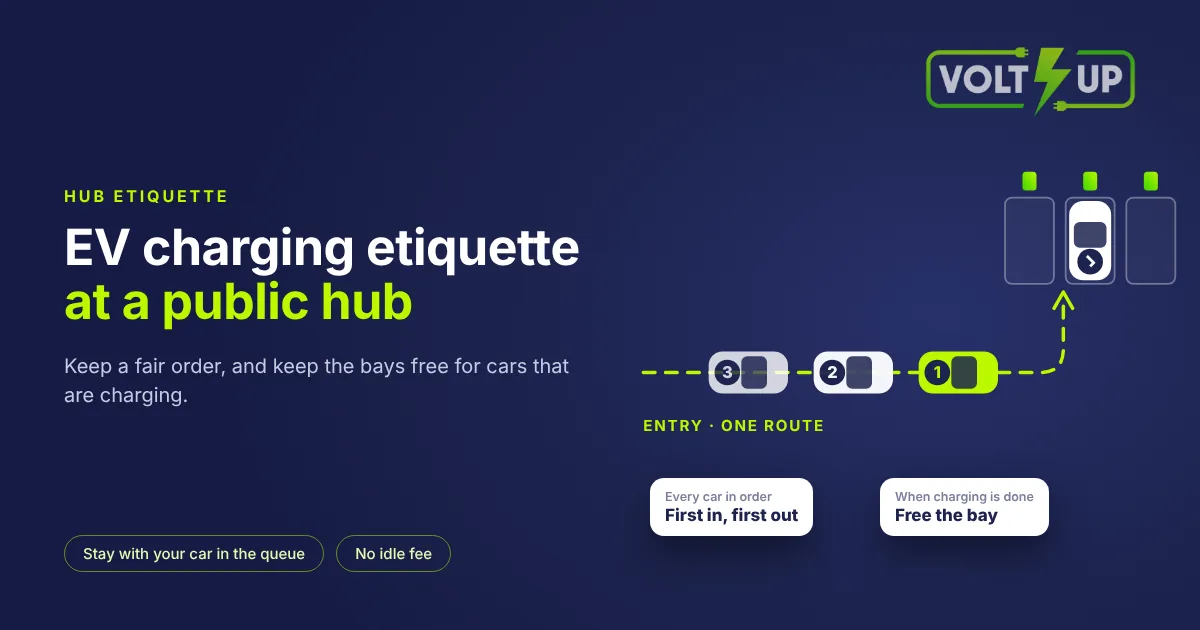
A car that has a charger to itself can take more, up to what its own maximum and its BMS allow. You do not need to pick a charger yourself: the team directs each arriving car to the charger that suits it, and cars are helped in order of arrival: first in, first out. The rest of a visit, from the operator plugging in to the end of the session, is in your first DC fast charge, step by step.
What you can do
Our team's advice to a driver who wants to charge as fast as possible is patience: charging is not as quick as filling up at a petrol pump.
Plan to stop at about 90%. The last part adds little range for the time it takes.
Follow the session in the VoltUp app: it shows the battery percentage and an estimated time, so you can decide when to leave.
If a session stops instead of slowing down, that is a different problem: read why a session stops, and how our operators fix it.
Questions drivers ask
Will my car always charge at the full charger power?
No. The car's own maximum, its BMS, the battery temperature and the charge level set the power, and two cars on one charger share it. Full answer
What is the difference between kW and kWh?
A kW is power, the speed at which energy flows into the battery. A kWh is the energy itself, and it is what you pay for: AED 1.20/kWh + 5% VAT (AED 1.26/kWh including VAT). Full answer
How can I charge faster?
Arrive with a low battery and stop at about 90%: the last part of a session is the slowest. The car's BMS, the battery temperature and a shared charger set the rest, and our team places you at the charger that suits your car. Full answer
What happens when two cars share a charger?
They share its power. Today a 120 kW charger with two cars gives each car a fixed maximum of 60 kW. Full answer
Can I charge to 100%?
Not at VoltUp. Sessions stop at 95% by our choice, so nobody wastes time and the next driver does not wait unnecessarily. For battery life we recommend about 90%. Full answer
More from VoltUp
How DC fast charging works at VoltUp: charger ratings, two cars sharing a charger, and the example cars.