EV charging for limousine fleets in Dubai: choosing a public charging partner
What to check before your limousine or taxi drivers charge at a public hub in Dubai: price, invoices, driver control, on-site help and contracts.
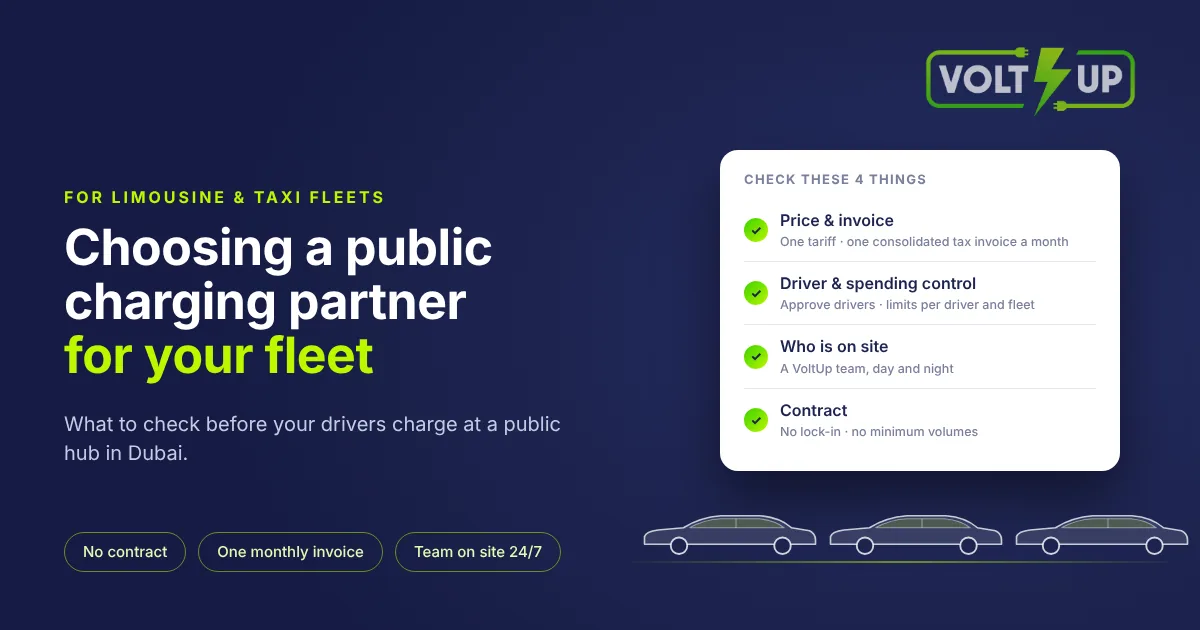
If you are choosing EV charging for limousine fleets in Dubai, or for a taxi or chauffeur fleet, check four things first: the price and the invoice, how you control drivers and payments, who is on site, and whether you are tied to a contract. At VoltUp, fleets pay per kWh from one prepaid fleet wallet, receive one consolidated tax invoice a month, and have no contract.
For accounts and set-up, see fleet charging at VoltUp.
Why we know this question
VoltUp grew out of the charging problems of our own limousine company in Dubai. That company started in 2024, and about 40% of its cars were electric.
From late 2024 to early 2025, demand for public charging far exceeded supply. We tried every charging app, and our drivers waited about 3 hours to charge for 1 hour. When an unmanned charger failed at night, nobody helped. There were arguments over the queue, and fines for waiting on the public road. One driver asked for a petrol car, because he could not earn.
What we learned from those years: often, though not always, it is more sensible to drive a little further to a hub and charge there than to wait at a single charger that serves two cars at a time. Fleets often underestimate the waiting time at such locations.
Questions to ask a public charging partner
What does a kWh cost, and does every customer pay the same? At VoltUp: AED 1.20/kWh + 5% VAT (AED 1.26/kWh including VAT), one tariff for fleet and private customers, day and night.
Are there extra fees? No parking, idle-time, minimum-session, adapter or connection fees, and no subscription.
What invoice do you get? One consolidated tax invoice on the 1st of each month, plus a VAT invoice for every session.
Can you control drivers and spending? Yes: you approve drivers, manage their RFID cards in the fleet portal and set spending limits per driver and per fleet.
Who is there when something goes wrong? A VoltUp team is on site 24/7.
Where do cars wait? Inside the hub, off the public road.
Can your cars charge? Most, but not all, EVs on UAE roads can, with VoltUp adapters for GB/T, CCS1 and Tesla (NACS) cars.
Are you tied in? No contract, no lock-in and no minimum volumes.
Price and invoices
Every customer pays the same tariff: AED 1.20/kWh + 5% VAT (AED 1.26/kWh including VAT). There are no discounts. The DC public charging fee in Dubai is set by DEWA's Infrastructure Regulation (Art. 6.1), and a discount or preferential rate below it is forbidden. Full answer
A typical customer session at our hub is roughly 45 to 50 kWh, from our own figures since opening.
Every session comes with a VAT tax invoice for the exact kWh charged, in the app and by email. On the 1st of each month the fleet also receives one consolidated tax invoice for the previous month's total usage, in kWh and AED. It shows our details and yours (name, TRN, location), the tax period, the total kWh and the VAT; the invoice of 1 November, for example, covers 1 to 31 October. The VAT certificate is not mandatory, but we recommend it, because VAT is charged on every kWh.
Usage reports for a period you choose download as CSV files, or the team prepares one for you. Full answer
If the tariff changes, fleet owners get a phone call, on top of the notice in the app, on the website, at the station and by SMS.
Drivers, cards and limits
To open a fleet account, we ask for the manager's name, phone and email, the company name as on the trade licence, the VAT certificate and a fleet email address. We create the account, and the fleet manager verifies the email address.
Drivers join in the VoltUp app: they enter their phone number, tap "Join fleet", and the fleet manager approves them. We can also add a driver after seeing an ID that shows they work for your company.
At the fleet manager's request, the on-site team links an RFID card to a driver's account. For rent-a-car fleets, a card can be linked to a car instead of a driver. RFID cards are free, and a lost card is deactivated and replaced free of charge.
Spending limits can be set per driver and per fleet. In the fleet portal at cpms.voltup.ae you manage drivers, RFID cards, invoices and reports. Drivers on a fleet account know that the fleet manager can see their charging sessions.
Paying for the fleet
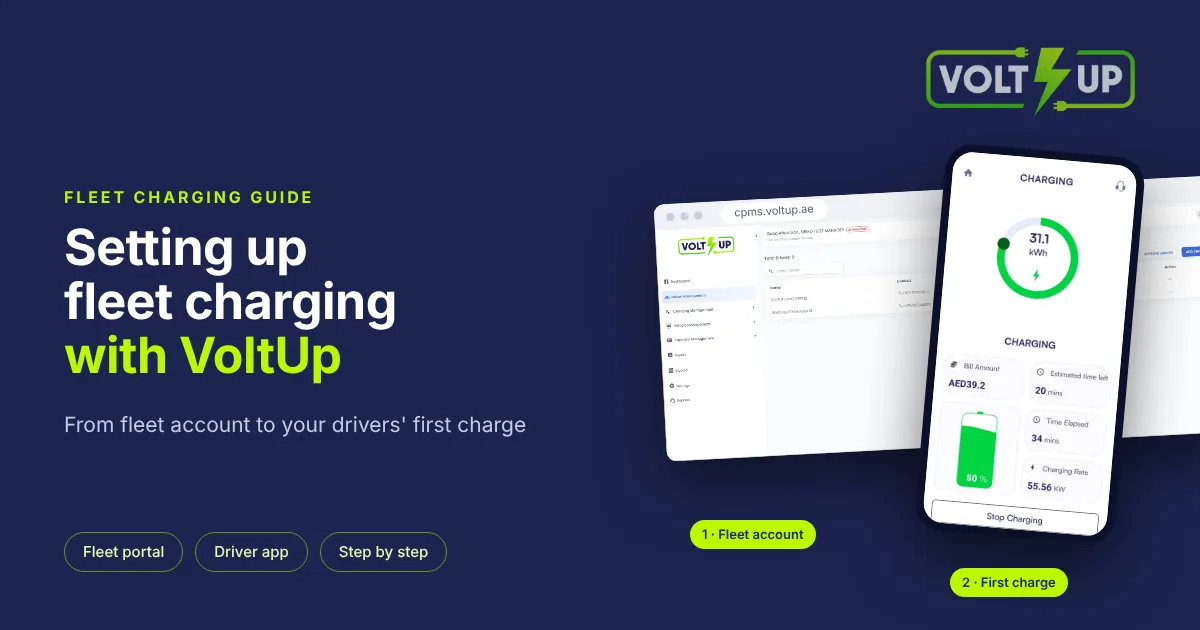
The fleet manager tops up one main fleet wallet, and every approved driver charges from it. Drivers start a session in the VoltUp app or with their RFID card, and the session is paid from the wallet. The wallet can be topped up with cash, by bank transfer, or through the payment gateway with Apple Pay, Google Pay, Samsung Pay, Mastercard or Visa. Each top-up produces a receipt sent to the fleet email address, and the balance never expires.
On site
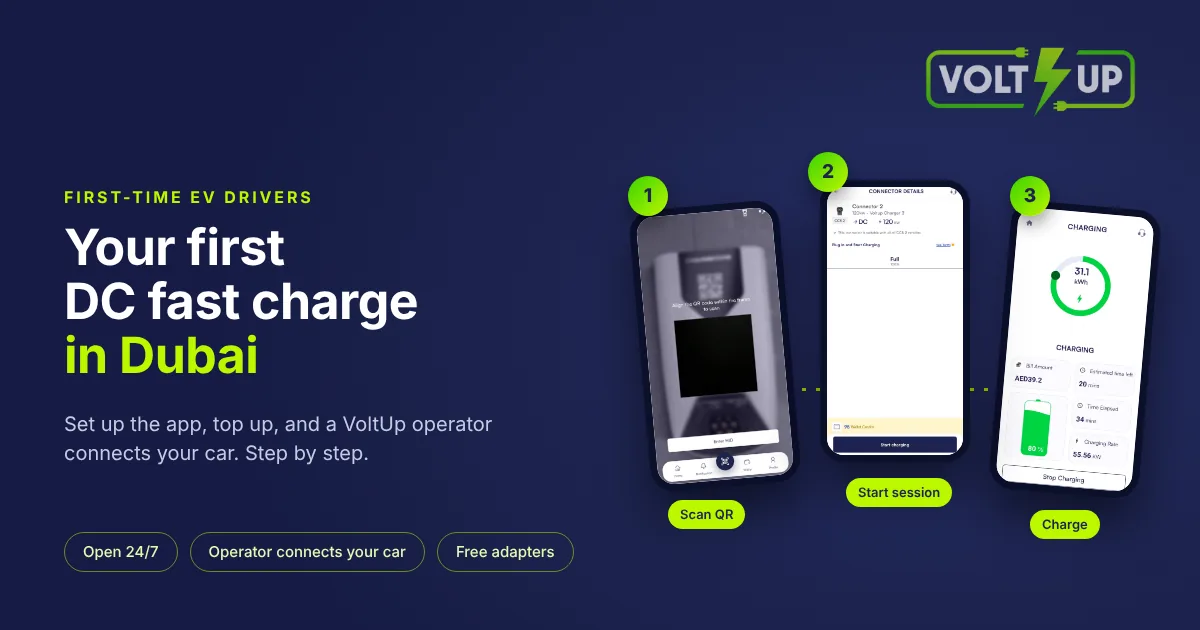
The hub is open 24/7, including public holidays, and a VoltUp team is on site day and night. For every customer, with no exceptions, a VoltUp operator connects the cable, and the adapter if the car needs one, and checks that the connection is stable. Adapters for GB/T, CCS1 and Tesla (NACS) cars are kept on site and are free to use.
Cars are helped first in, first out, with no priority for anyone. The hub is a private plot of about 40,000 sq ft, and cars wait inside the hub, off the public road. Drivers stay with their car while it waits in the queue; once a VoltUp operator has connected it to a charger, they may leave and do what they want.
Our own monitoring reads every charger's status every 5 seconds. When a charger stops, the team sees it live and sends a VoltUp operator to the bay. Our chargers have 99.7% uptime (measured).
Autocharge
Since 3 November 2026, fleets can ask for Autocharge. The charger recognises the car by its vehicle ID when it is plugged in, and starts the session without the app or an RFID card. It is for fleet customers, for example limousine, taxi and rent-a-car fleets; private drivers cannot get it. Every Autocharge car belongs to the fleet wallet, and its sessions are paid from that wallet. Autocharge is free of charge, for supported cars. You request it through your dedicated key account manager or on WhatsApp to the fleet team. Full answer
Support and commitment
Every fleet company has two dedicated key account managers and its own WhatsApp group with the VoltUp team, for all questions. There are no minimum volumes. There is no contract or lock-in: you pay per kWh and are free to stop. Full answer
To start, send a WhatsApp message to +971 52 557 6145; phone and info@voltup.ae work too. Full answer
Questions fleet managers ask us
These are the questions fleet managers put to us before they start.
How many chargers do you have?
Today the Umm Ramool hub has 4 DC chargers, 8 CCS2 connectors and 8 covered charging bays. When two cars share one charger, its power is shared between them. The VoltUp Umm Ramool station page has the details.
You have one hub. Why choose VoltUp?
Today we have one hub, in Umm Ramool. In our view, fleets choose a hub built for throughput, with a team on site and facilities. At busy public chargers, charging often means waiting in the car, in the heat, or on the public road, where drivers risk a fine. The facilities include an air-conditioned waiting area, a prayer room, toilets, a shower, free Wi-Fi and cold drinking water.
How long does a session take?
That depends on the car: its battery management system, battery temperature, charge level, and whether two cars share a charger. The charger screen and the app show the battery percentage and an estimated time until done. Sessions stop at 95%, and we recommend charging to about 90% for battery life.
Do you have adapters?
Yes. We keep more than 35 adapters on site for GB/T, CCS1 and Tesla (NACS) cars, and the team brings the right one. Cars sold through official GCC dealers use CCS2 and plug in directly, and CHAdeMO is not supported. See which EVs can charge at VoltUp.
Can my drivers get fines?
At busy public chargers, drivers often wait on the public road for their turn and risk a traffic fine. Our hub is a private plot, and cars wait inside the hub, off the public road.