EV Charging Cost per Shift in Dubai, Calculated
How taxi, limousine and fleet drivers can estimate what an EV top-up costs in Dubai, with worked BYD Han and Tesla examples.
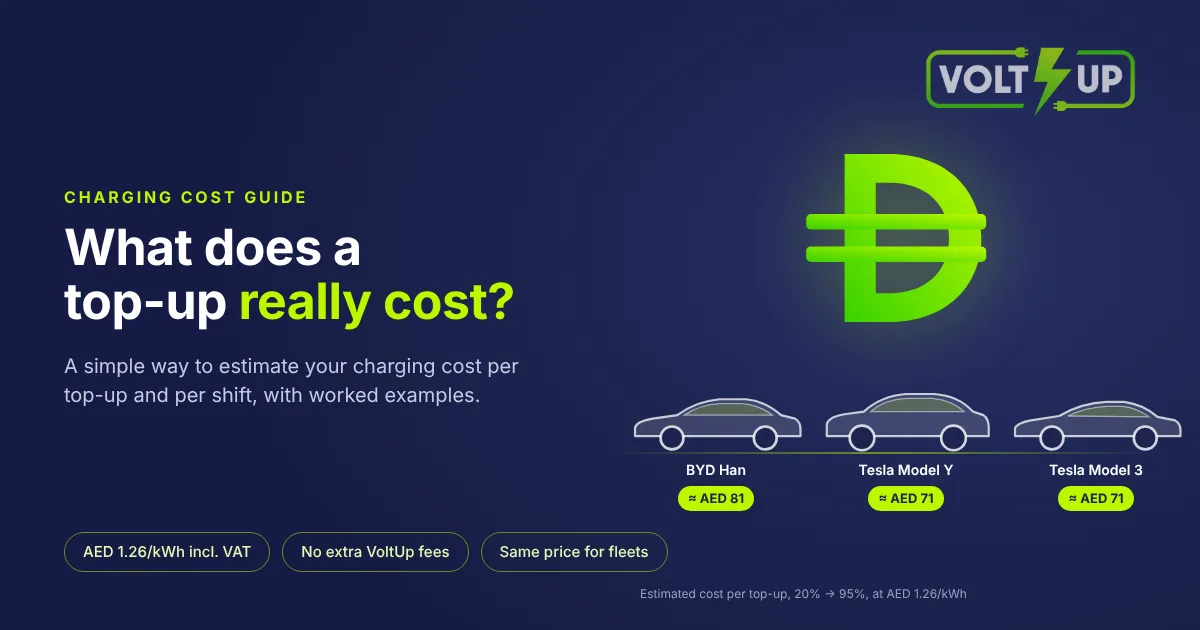
For a taxi, limousine or other commercial EV driver, the price per kWh is only part of the picture. What you really want to know is what a top-up costs, so you can get back on the road for the rest of your shift. There is no single cost for a working shift: it depends on how much energy you add, how much your car uses and the current tariff. This guide shows a simple way to estimate it, with worked examples for cars we see at VoltUp's Umm Ramool station in Dubai.
What do you need to know before you calculate?
Three numbers are enough for a good estimate:
How much energy you add (kWh). This depends on your battery size and how far you charge: for example, from 20% to 95%.
Your car's consumption (kWh per 100 km). This tells you how much driving you get from that energy.
The tariff (AED per kWh). At VoltUp this is currently AED 1.20 per kWh + 5% VAT (AED 1.26 including VAT), with no additional VoltUp fees. Fleet and private customers pay the same tariff. The tariff can change, so check the current VoltUp tariff before you rely on it.
The basic calculation
Estimated battery energy added ≈ usable battery (kWh) × (end % − start %)
Estimated energy cost = estimated battery energy (kWh) × tariff (AED/kWh)
For example, charging a car with a 75 kWh usable battery from 20% to 95% adds about 75% of 75 kWh, which is roughly 56 kWh. At AED 1.20 per kWh + 5% VAT (AED 1.26 per kWh including VAT), that is about AED 71.
This is an estimate of the energy stored in the battery. The charger measures energy before it reaches the battery, and some energy is lost as heat during charging. So the kWh recorded for your session, and the amount you pay, can be slightly higher than this estimate. Your receipt in the VoltUp app shows the actual kWh and amount for each session.
A top-up or a shift: which should you calculate?
There are two useful ways to look at it.
Per top-up. What does it cost to go from my arrival charge to my target charge? This is the simplest number. At our Umm Ramool station we see that many drivers arrive at around 20% and charge to 95%. Under our current charger setting, sessions stop at 95%. For battery life we recommend charging to around 90%, but always follow your vehicle manufacturer's guidance.
Per distance. What does it cost to drive a certain number of kilometres? Use:
Estimated cost per 100 km = consumption (kWh/100 km) × tariff (AED/kWh)
Then multiply by the distance you expect to drive. This makes it easier to compare cars, or to plan the charging budget for a shift.
Worked examples: cars we see at our station
The most common car we see at our Umm Ramool station is the BYD Han. We also include the Tesla Model Y and Model 3, which drivers also bring to our station.
Each 20% → 95% figure below estimates the energy stored in the battery, based on the stated usable capacity. It is not an exact billed-session amount: because of charging losses, the charger can record more kWh than this calculation.
| Car (variant used for the figures) | Usable battery | Consumption estimate (EV Database) | 20% → 95%: estimated battery energy | 20% → 95%: battery-energy cost estimate | Range added, using the EV Database estimate | Estimated cost per 100 km |
|---|---|---|---|---|---|---|
| BYD Han (85.4 kWh) | 85.4 kWh | 18.0 kWh/100 km | about 64 kWh | about AED 81 | about 356 km | about AED 22.70 |
| Tesla Model Y Long Range AWD (2022–2025) | 78.1 kWh | 16.9 kWh/100 km | about 59 kWh | about AED 74 | about 347 km | about AED 21.30 |
| Tesla Model 3 Long Range RWD (2024–2025) | 75.0 kWh | 13.6 kWh/100 km | about 56 kWh | about AED 71 | about 414 km | about AED 17.10 |
Calculated at AED 1.20/kWh + 5% VAT (AED 1.26/kWh including VAT; tariff confirmed 21 October 2026). Battery and consumption figures are EV Database estimates for the named variants (BYD Han, Tesla Model Y Long Range AWD, Tesla Model 3 Long Range RWD), retrieved October 2026, except the Tesla Model Y battery: 78.1 kWh is the figure we use for our price examples by car. They are blended estimates based on EV Database's own method. They are not VoltUp measurements and not a forecast for Dubai summer driving. Other variants of the same model can have a different battery and consumption. All figures are rounded estimates, not guaranteed costs or ranges.
For comparison: across sessions recorded at our station since it opened in February 2026, a typical customer session was roughly 45 to 50 kWh. At the tariff confirmed for this article, that recorded session energy comes to about AED 57 to AED 63. This is not a guaranteed session size.
Example: planning a shift. Suppose you expect to drive 300 km in a shift. That is only an example; use your own distance. These are estimates of driving energy. They do not predict the exact kWh recorded during a charging session.
BYD Han: (300 km ÷ 100) × 18.0 kWh/100 km = about 54 kWh → about AED 68
Tesla Model Y Long Range: (300 km ÷ 100) × 16.9 kWh/100 km = about 51 kWh → about AED 64
Tesla Model 3 Long Range: (300 km ÷ 100) × 13.6 kWh/100 km = about 41 kWh → about AED 51
Why your real consumption can be different
The consumption figures above are a starting point, not a Dubai forecast. Real consumption changes with:
Summer heat. We see that some drivers use more energy in Dubai summer conditions, when the air conditioning works harder. How much depends on the vehicle, route, speed and driving conditions.
Speed and road type. EV Database's own estimates for these cars show a shorter range on the highway than in the city: faster driving usually uses more energy per kilometre.
The exact version of your car. Different variants can have different documented consumption figures. Check the specification of your exact vehicle before using a published estimate.
VoltUp has also observed that some commercial drivers charge more often during the busier winter season. This is an operational observation, not a forecast of anyone's individual driving needs.
For your own planning, use your car's recent dashboard consumption and your actual session receipts instead of a general example.
How fleets can move from estimate to real numbers
For fleet managers, an estimate is useful for planning, but the real numbers are in your charging records. A VoltUp fleet account includes:
a monthly consolidated tax invoice, issued on the first day of each month for the previous month's total usage in kWh and AED
usage reports for reconciliation, which the fleet manager can download for the relevant period or ask the VoltUp team to prepare
Comparing those totals with the kilometres your drivers report gives you your fleet's real cost per kilometre. More about fleet accounts, invoicing and usage reporting is on the fleet page.
Where to check the current tariff
The tariff in this article was confirmed on 21 October 2026. Always check the current VoltUp tariff before you calculate. The VoltUp app lets you follow your charging progress, and your receipt shows the kWh and amount after each session. For station details, see VoltUp's Umm Ramool charging station page.